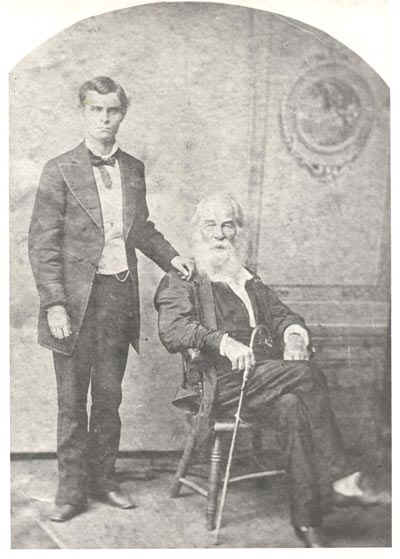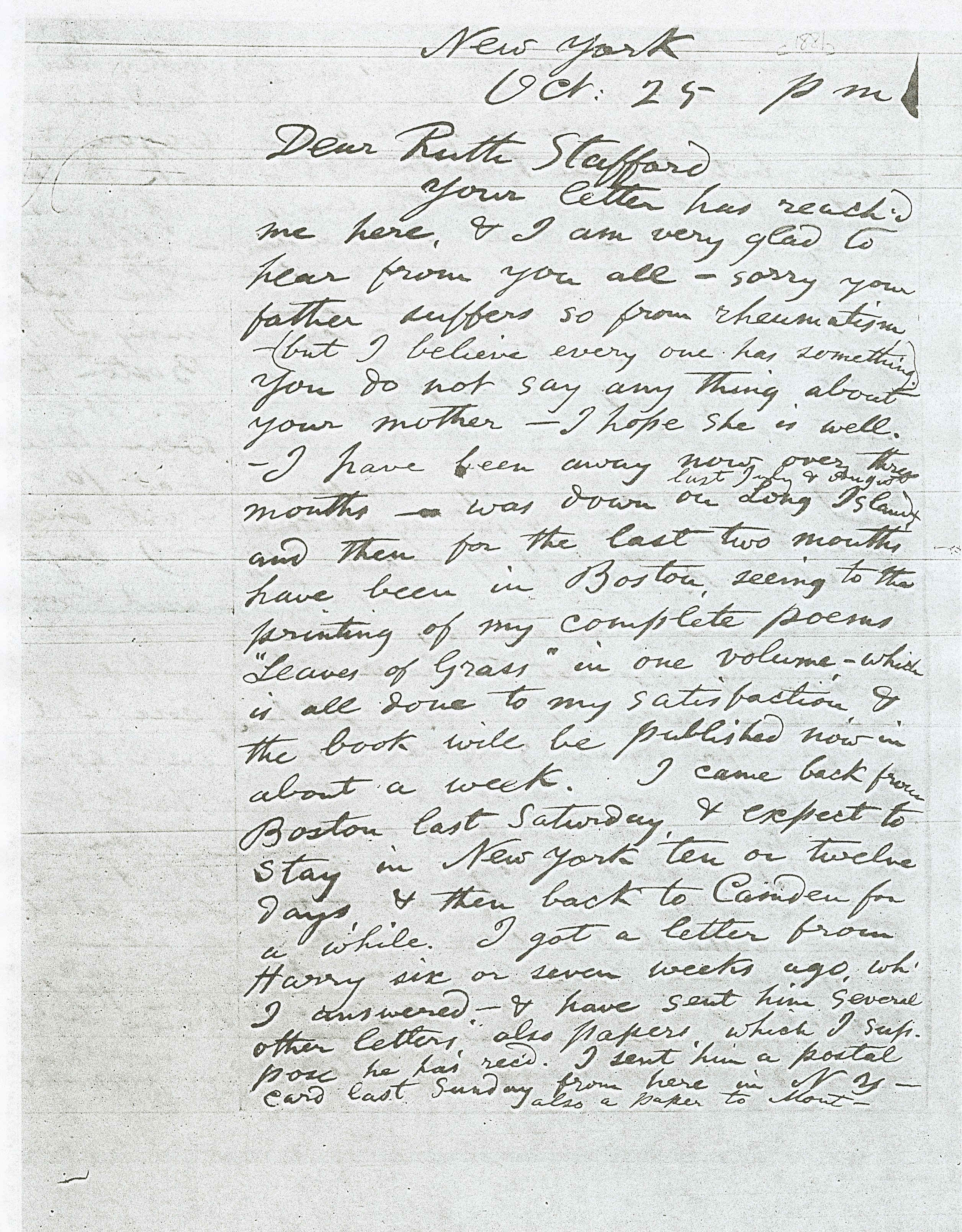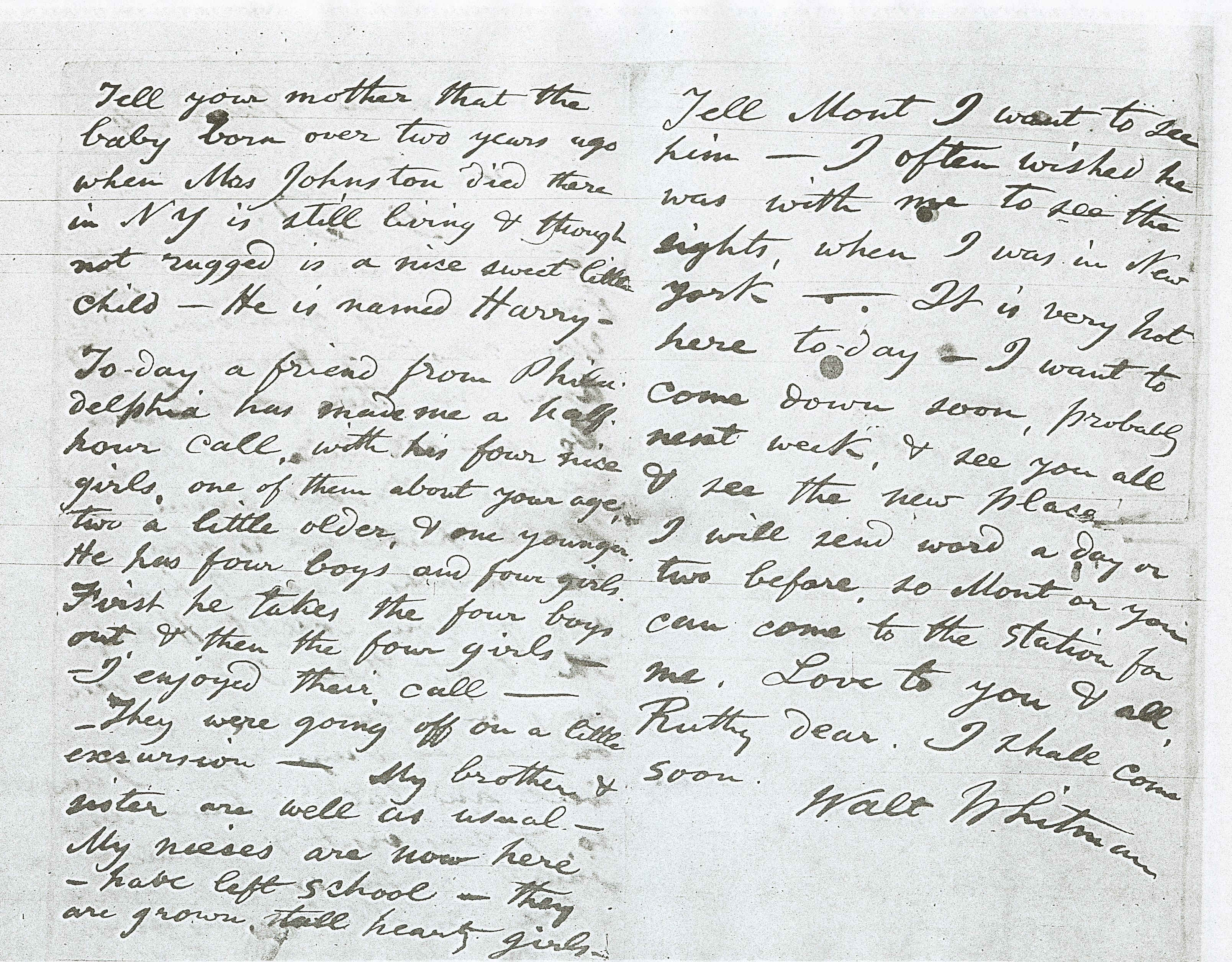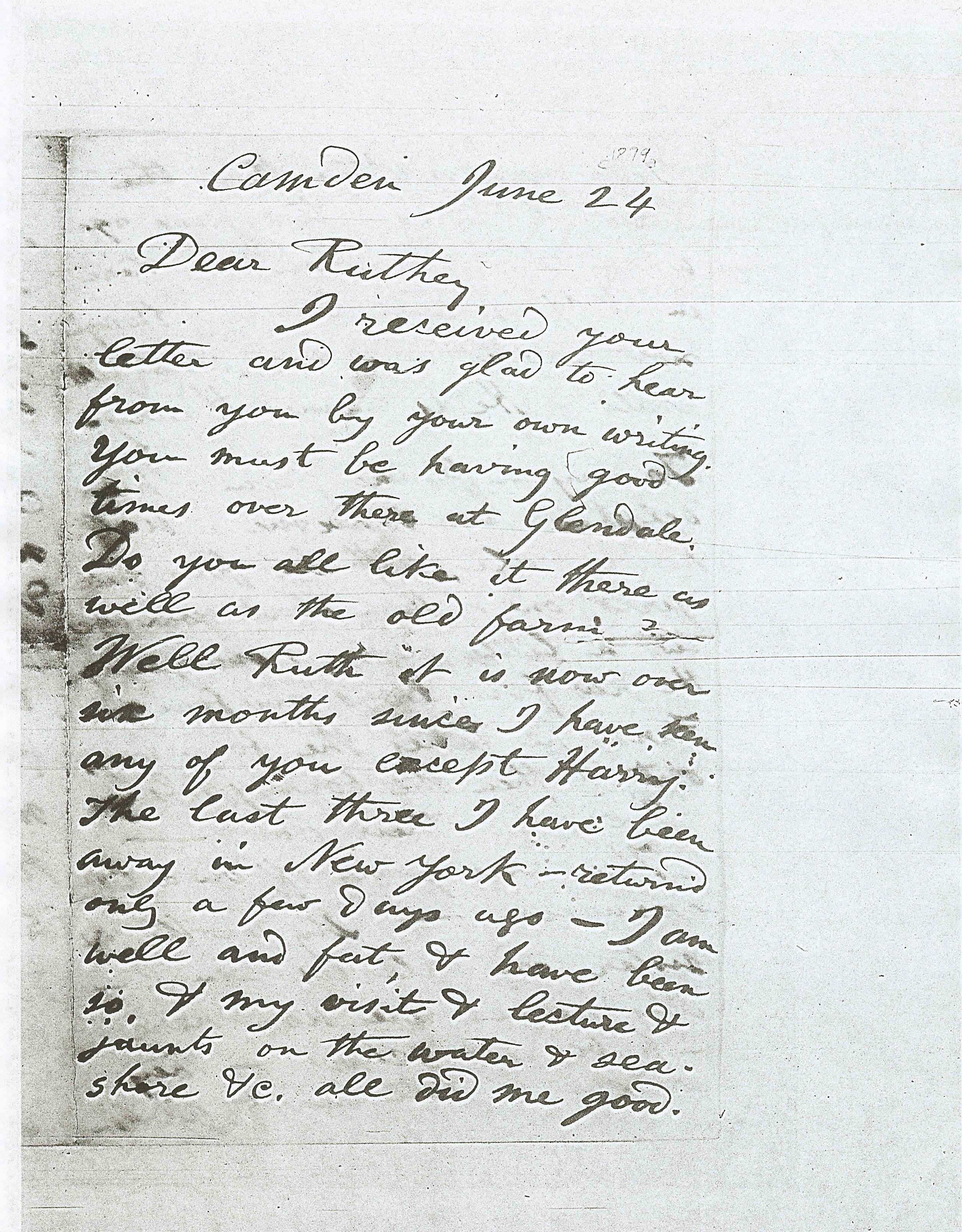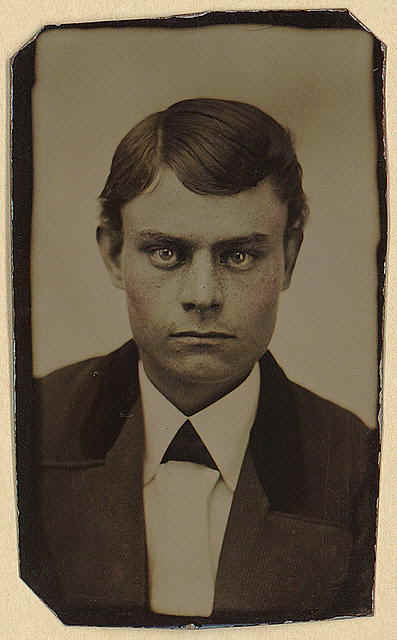
Harry Lamb Stafford
"Harry Lamb Stafford, Ruth's brother. He was
also Walt Whitman's Paramour although Harry did marry and fathered three children. Harry's
bloodline is alive and well to this day"
09.30.2007 |
Whitman seemed to endure his final months through sheer force of will.
He was in fact very sick, beset by an array of ailments. For some time, he had been making
preparations for the end. He had a large mausoleum built in Camden's Harleigh Cemetery, on
a plot given to him in 1885, shortly after the cemetery was opened. The large tomb was
paid for in part by Whitman with money donated to him so that he could buy a house in the
country and in part by Thomas Harned, one of his literary executors. (Eventually, several
family members–Hannah, George, Louisa, Edward, and his parents—were reinterred
in the same tomb, on which the inscription reads simply "Walt Whitman.") On
December 24, 1891, the poet composed his last will and testament. In an earlier will of
1873 he had bequeathed his silver watch to Peter Doyle, but now, with Doyle largely absent
from his life, he made changes, giving his gold watch to Traubel and a silver one to Harry
Stafford.
Walt Whitman Cronology
1877 28 January, lectures on Thomas Paine in Philadelphia. Painted by George W. Waters in
New York. May, Edward Carpenter visits Whitman in Camden; Dr. Richard Maurice Bucke visits
Whitman and becomes a close friend. Whitman visits Burroughs in Esopus, New York,
with Harry Stafford.
In addition to his literary friends, Whitman continued to maintain key emotional ties with
working-class men, often substantially younger men. Whitman's relationship with Doyle
gradually dwindled as the two men saw less and less of one another. Harry Stafford
displaced Doyle as his boy, his "darling son." Stafford, an emotionally
unstable young man of eighteen when Whitman first met him in 1876, did odd jobs at the
Camden New Republic. The Stafford family regarded Whitman as a type of mentor and were
pleased with the poet's interest in the young man. Stafford's mother was
especially solicitous of Whitman as he strove to nurse himself back to health after his
stroke through the restorative powers of the natural scene at the Staffords' farm near
Timber Creek, approximately ten miles from Camden. The nature of
Whitman's relationship with Stafford remains mysterious. We know that the poet and Harry
wrestled together (leaving John Burroughs dismayed at the way they "cut up like two
boys"); that a friendship ring given by Whitman to Stafford went back and forth
numerous times (with anguished rhetoric) as the relationship developed; and that they
shared a room together when traveling. Whitman and Stafford also discussed attractive
women (as the poet had with Peter Doyle). After Stafford married in 1884, the two men
maintained a friendly relationship.
Specimen Days was issued as a prose counterpart to the 1881-1882 Leaves of Grass. Whitman
described it as the "most wayward, spontaneous, fragmentary book ever printed,"
and, as an autobiography, the book is anomalous. Whitman sheds little light on what
remains a central mystery: the development of the first edition of Leaves of Grass. After
a brief section on family background, Whitman moves rapidly past his "long
foreground" to focus instead on the war (relying heavily on material used in
Memoranda). Aware that no other major writer could match his direct and extensive
connection to the war, he continues to argue that the hospitals were central to the war
just as the war was definitional for American experience. Following this section, Whitman
shifts to nature reflections evoked by the Stafford farm setting at Timber Creek where
Whitman underwent a self-imposed, idiosyncratic, but effective regimen of physical therapy
(including wrestling with saplings and taking mud baths) to restore his body from the
ravages of stroke. He also describes his 1879 trip to attend the
quarter-centennial celebration of the Kansas settlement and to visit his brother Jeff in
St. Louis. Whitman journeyed as far as Denver and the Rockies, finding in the landscape a
grandeur that matched his earlier imaginings of it and a ruggedness that justified his
approach to American poetry. Consistently in Specimen Days, Whitman kept his standing in
the national pantheon in mind. In sections such as "My Tribute to Four Poets"
and the accounts of the deaths of Emerson, Longfellow, and Carlyle, Whitman seeks to
establish a newly magnanimous position in relation to his key predecessors. Showing a
generosity rarely displayed in his criticism before, he now praises fellow poets he once
derided as "jinglers, and snivellers, and fops." Specimen Days has only recently
begun to get much critical attention, and it is now being read as an eccentric and
experimental work, a prose counterpart to Whitman's radically new poetry.
Walt Whitman Quarterly Review
Golden, Arthur. "A Recovered Harry Stafford Letter to Walt Whitman," 5/4:40-41.
|