Rung & Bill!
Rung Sangprasit's & Bill Smart's Personal Website
|
Eggs A short story by W. D. Smart |
|
Luba was furious. “What do you mean we can’t go on the cruise? I’ve
already told everyone we’re going! I’ve made plans!” She spit her
words at Ted like a viper. “Helen and I are going to Chicago to
start shopping this weekend!”
Ted was sitting at the kitchen table. His glasses had slipped down
and were hanging precariously on the tip of his nose. Stacks of
opened envelopes and papers were scattered over the chrome tabletop.
His wife sat directly across from him, but he wished there was much
more distance. The bitter smell of freshly brewed espresso seemed to
accentuate the acidic situation. The bright yellow walls and the
polished tile floor reflected the sunshine streaming in through the
large windows that looked out onto the backyard and swimming pool.
The kitchen was uncomfortably bright. He squinted at her over the
tops of his glasses.
“I was hoping we could go too,” he weakly responded, “but there are
just too many bills. This new car payment is killing us! And I had
no idea our insurance would go up so much.”
“I’m supposed to drive!” Luba blurted out.
“What do you mean?” Ted was confused. He was often confused when
talking with his wife.
“I just told you! I’m going to Chicago Saturday with Helen – and
June and Margaret. I’m supposed to drive! What will I tell them?”
Luba glared at her husband across the table and slowly shook her
head. “My husband…, the CPA..., the big shot accountant!” she
continued sarcastically. “Is this what I get for giving up my life
so you could get your degree? A big shot CPA who’s so good with
accounting that he can’t even find the money to take his wife on
vacation?” She leaned forward across the table towards him and asked
again, “Just what the hell am I supposed to tell them?”
Ted squirmed a little but forced himself to look her directly in the
eye and said as gently as he could, “I don’t know what you can tell
them. We just can’t afford to go. It’s impossible.” Ted paused and
then suggested, “I guess you could still go shopping with them.”
“Oh, sure! For what?” Luba rose suddenly from her chair and planted
herself in front of the windows, her arms flailing as she continued
her punishing diatribe. “I’ll just chauffeur them up to Chicago and
stand around while they buy new bathing suits and sunglasses and
cocktail dresses! That’ll be great! Maybe, if we could take the time
out to go to a drugstore somewhere, I could buy one of those
cardboard cameras so they could take photos to show me what a good
time I missed! Can we afford that?”
Luba’s words stabbed at Ted. He sat staring at her silhouette framed
in the sunlit windows. She was still stunningly beautiful, just as
striking as when he first saw her ten years ago at college. They
were both from immigrant families and had met at a mixer sponsored
by the Ukrainian Students Association that they had attended at
their parents’ insistence. Other than that, they had little in
common. She was from Chicago and an upper-middle-class family, an
only child. He was raised on a small farm in southern Indiana and
the oldest of three children. At that time, however, he had an edge.
He was a confident senior, and she an impressionable freshman. He
had thought then that their shared ancestry would assure shared
interests and shared values. He had been wrong.
“Can we?” Luba said with one last stab and a final twist. “Can we
afford that?” When she received no response, she spun around and
stormed out of the kitchen.
Ted continued to stare at the windows where she had been standing.
He could still see the imprint of her image on his retina left by
the bright sunlight. When her image faded, he turned and looked at
the bills spread out on the table. “Yes,” he said softly to no one,
“I guess we could afford that. But just barely.”
Ted gathered up the papers from the table and put them away. He
wandered into the living room, still dazed from the disastrous
bill-paying session and the ensuing tongue-lashing. The stark,
ultra-modern furniture seemed to mock him. It was made mostly of
glass and stainless steel. Where there was fabric, it was a
monotonous repetition of geometrical black and white patterns. As
far as Ted was concerned, it was both visually and physically
uncomfortable. The sofa had cost a fortune, as had the rest of the
furniture. He did not even want to think about how much they had
paid for the white pile carpet under his feet. Why had he let her
talk him into all this? This was not the lifestyle he wanted. He was
a simple man. He wanted to remain a simple man. He wanted to have a
simple life — no frills, no problems, no fights, and certainly no
outrageous bills.
He soon found himself going down the stairs to the basement and
began to feel more at ease. The coolness rose to meet him, or
rather, he descended into it, like slowly walking into a cool, still
pond. A soft light found its way into the room through the
half-windows near the ceiling. The flat gray of the bare concrete
walls further dampened the light. He reached out and put his palm on
the wall. It was cool, almost damp, and gave off a pleasant musky
smell.
In the sanctuary of the basement, Ted felt much better. He moved
past his workbench to the wooden crate sitting on the floor. He
removed the top and started unpacking the contents: a box of
candles, jars filled with bright colored liquids, yellowed paper
covered with fine, handwritten Cyrillic script and neatly drawn
patterns, sieve-like ladles, a package of beeswax, and a
fragile-looking instrument with a bowl at one end that resembled a
long slender pipe. After he had arranged all of these on his
workbench, he reached into the crate once more and carefully removed
several small boxes. He set them gently down on the workbench and
began extracting and unwrapping the precious contents.
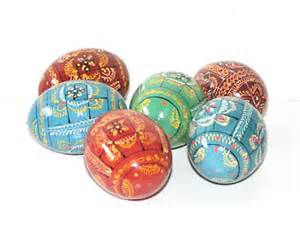
Eggs. Beautiful eggs, Ukrainian eggs, brightly colored, lovingly
decorated in fine, delicate lines inscribed with wonderfully
intricate patterns. There were circles, stars, mysterious ciphers,
outlines of birds, chocks of wheat, and a multitude of complex
geometric figures. Even in the dimly lit basement, the eggs shone as
their protective lacquer finish reflected all available light. These
were pysanky. These were Ted’s legacy, a gift from his
grandmother. Along with them, he had also received the ultimate gift
– the knowledge of how to make these marvelous works of art.
Ted walked over to the basement refrigerator and opened the door.
The refrigerator light was out, but the bright light above his
workbench helped him locate the dozen extra-large eggs he had
brought home earlier in the week. He carried the eggs to his
workbench, carefully removed them from the Styrofoam case, and
placed them on the tabletop.
He had planned to start decorating the eggs that afternoon after the
family outing to the park, but he needed something to do now. He
needed an escape from the unpleasant confrontation he had just had
with Luba.
Fifteen minutes passed, and a faint smell of vinegar lingered as Ted
finished washing the eggs. After carefully drying them with a soft
cloth, he began to candle each one to inspect for hairline cracks.
Any imperfection in the shell would eventually allow air to seep
into the finished egg and cause it to putrefy. Ted was all too aware
of the tedious work ahead of him. He did not want to go through the
effort of creating a beautiful egg, only to find it had a fatal
flaw.
As he held each egg near the candle flame and slowly rotated it in
his fingers, he began to feel a warm closeness moving down upon him.
The subtle texture of the eggshell massaged his fingertips, and the
creamy smoothness of the shell’s hue lulled him into a soothing
reverie. He could feel a connection forming, an extension reaching
for him. The feeling wove its way through past generations towards
him as if the craft he was performing was a vehicle for a powerful
but unseen flow of relationship.
After candling all the eggs, Ted gathered his tools together and
inspected them. He was especially careful in examining the kistka,
the slender instrument used to apply the wax. The kistka is
held in one hand like a large ink pen. On the writing end is a bowl
with a protruding tip. The bowl would be packed with wax and then
heated over an open candle flame. As the wax melted, it flowed from
the bowl out the tip and onto the egg. He had tips of various sizes
that would cause the wax to flow in different widths. He selected a
medium tip to start the morning’s work.
At first, the melted beeswax flowed on so transparently he would
have to stop to determine what part of the pattern he had already
done. He knew that soon however, the carbon from the candle’s flame
would darken the bowl of the kistka and the melted wax,
causing it to flow in distinct black lines. He preferred this
traditional method to using the new electric kistkas. They
required coloring to be added to the wax to achieve the same effect.
The first pattern was slowly emerging. He had chosen a traditional
star pattern because of its simplicity. Even though he had performed
this craft every year for almost fifteen years, the first egg each
new Easter was a re-learning experience for him.
His young daughter Marie silently appeared in the room and climbed
up onto a chair opposite him. She kneeled on the chair so she could
see over the tabletop. She placed her elbows on the table, resting
her head in her hands, and crossed her legs behind her. She watched
his every move. She looked like she was dressed for church. She wore
a delicate lilac dress that barely concealed a mass of stiff
petticoats. Her legs were covered with white tights, and she wore
shiny black sandals. Her curly dark hair was pulled back into a neat
ponytail and secured with a matching lilac bow. She shifted slightly
from time to time, causing her starched petticoats to rustle.
At first, he paid no attention to her but soon found himself
blurting out pieces of information if for no other reason than to
break the silence. “You must move the kistka in long smooth
strokes. You do this to apply the wax evenly. It’s very important to
get the lines the same width so the patterns on the egg will have
distinct, neat borders.”
Marie listened, seemingly unimpressed. This annoyed her father and
caused him to continue talking, searching for something which would
catch her attention.
“After this first pattern is drawn, I’ll put the egg in that bottle
of yellow dye. When I remove the egg, all the shell will be yellow
except for the lines I have drawn with the wax. The wax protects
that part of the egg from the dye. Do you see what I mean?” he
asked.
Marie nodded her head yes. Ted was encouraged and continued.
“After it has dried, I’ll draw more lines on it with the kistka
and then dip it in another color. This is the way the beautiful
patterns emerge. See these drawings?” He showed her the papers his
grandmother had given him, pages and pages of patterns and
instructions handed down for generations.
Marie nodded her tiny head slowly and looked at the bottle of dye.
“It looks like Kool-Aid. Can I put the egg in the color?”
Before Ted could answer Luba had opened the door at the top of
stairs. Without coming down, she called out, “Marie? Ted? Come on,
let’s go! We don’t want to be late for the hunt.”
Marie quickly slid down from her chair and ran up the stairs leaving
Ted to turn off the burner and hastily store his tools. He reached
the car just as Luba and Marie were getting in.
“Watch her fingers!” scolded Luba as Ted started to close the car
door. Little Marie grinned at her father from inside the backseat
and edged away.
“She wasn’t even near the door,” Ted muttered defensively as he
swung into the seat behind the wheel.
“Well, you never notice where she is or what she’s doing,” Luba
continued. “It’s always left to me to look after her. You’d think
you’d act like a father once in a while and help out.” As Ted
started the car, she added, “I thought you were going to change your
clothes.”
Ted drove away in silence. His wife had on a long, white dress
decorated with smart black and silver trim. She wore a fashionable
wide-brimmed hat with a lilac ribbon. Both she and Marie looked like
they were going to a fancy tea party. Ted had on relaxed khaki
cotton pants and a loose-fitting knit shirt. He looked like he was
on his way to play golf. Luba turned almost all the way around in
her seat and talked softly to Marie telling her about the egg hunt
which was to take place at the park. This was Marie’s first egg hunt
and the first chance for her to wear the lilac dress that Luba had
brought home from one of her frequent shopping trips to Chicago.
“It’s beautiful, isn’t it?” Luba had asked proudly when Marie first
modeled it.
“It’s very nice.” Ted had said, but he was thinking, ‘How much did
it cost?’
Luba was telling Marie about all the other pretty dresses she would
see at the hunt. She talked about the fabulous eggs and the Easter
Bunny who had hidden them early that very morning. She told her they
were like the eggs they always have at home on the Easter table, the
ones Ted’s grandmothers had made.
Ted almost broke his silence to protest this last part. ‘Fabulous’
eggs indeed! The eggs used at the park today would be hollow plastic
eggs, each containing a small piece of candy or toy. They were
nothing like the precious ornamental eggs made by his grandmothers.
How could she compare those cheap plastic eggs to the works of art
so reverently created by their families in the old country?
Luba continued to talk softly with Marie as Ted drove towards the
park. As Luba’s voice droned on, his thoughts turned to warm spring
evenings on the farm when his grandmother had rocked him softly in
her lap on the porch swing. She had told him how the eggs were such
a special part of the spring festivals in the old country. The
decorated eggs represented new life that burst forth from the
thawing earth after the long, dark, and cold Ukrainian winters.
These eggs promised fertility. They protected homes and barns from
fire. A bowl of decorated eggs would bring wealth and protection
from the mischievous pranks of evil spirits. The most highly prized
were the multi-colored, highly ornamented eggs called pysanky.
These were made from raw eggs, but during the decoration process,
they were completely sealed and would keep indefinitely. The
‘fabulous’ park eggs were vaguely reminiscent of krashanka,
the boiled, edible, single-colored eggs given to families to ensure
health and an abundant harvest. The park eggs were stamped out of
cheap plastic. After they had been found, broken open, and their
tacky prizes extracted, the shattered pieces would be discarded and
scattered around the park. No one would take them home. No one would
use them as a centerpiece for the Easter meal or put them in places
of distinction on the mantelpiece. They had no promise of life or
rebirth about them.
When Ted arrived at the park, he found the parking lots full. He had
to ease off the side of the road in front of a line of cars that had
been forced to do the same. It had rained the day before, and there
was soft mud along the edges of the pavement. Ted finally stopped
with two wheels hanging off the road, causing the car to lean
heavily to one side. Luba and Marie awkwardly climbed out of the
high side of the car and onto the pavement. They hadn’t gone twenty
feet until Marie stepped in some mud, smudging her shiny black
shoes.
“Look at her shoes! If we’d left when I wanted to, we’d have found a
proper parking space,” Luba said as she stopped to take care of
Marie.
Marie cried a few tears until Luba borrowed Ted’s handkerchief to
wipe her face and then clean her shoes. They finally reached the
asphalt path and walked quickly towards the gathering mob of people
surrounding the starting line for the egg hunt.
The mayor explained the rules and boundaries of the hunt. There
would be two egg hunts: a regular one for school-aged children and a
special one for pre-school toddlers. The regular hunt would span
almost the whole park, and eggs had been hidden everywhere.
“I’d even look in the trees,” advised the mayor. “The Easter Bunnies
have been busy all morning,” he continued. “There are about five
hundred eggs out there. Every egg has something in it. Some have
candy, some toys…, and some very special eggs, golden eggs…” he
emphasized this last point very carefully, “…have a
twenty-five-dollar savings bonds in them!” There was an eruption of
excited clapping.
“Those of you that have preschoolers need to go with Mrs. Geraldine
Simms, the woman in the lovely blue dress and hat.” He pointed to a
tall, slender woman who was waving her hand over her head, “She will
take you down to the tennis courts.” Luba took Marie’s hand and
started off after Mrs. Simms. Ted followed closely behind.
The toddler hunt was to take place on the tennis courts. The park
had three tennis courts built side-by-side. The nets had been taken
down, and the net posts had been decorated with green and white
crepe paper. They resembled small, wrinkled Christmas trees.
Scattered over the surface of the courts were the eggs. They were
plastic eggs of single colors: red, white, green, blue - and a few
special golden eggs. Ted counted three of these, placed about
mid-court, one egg on each court.
Mrs. Simms carefully tiptoed her way through the scattered eggs to
the center of the courts and called for everyone’s attention. She
proceeded to explain the rules. The children were not to go onto the
courts until she blew her whistle. She held this up for everyone to
see. The parents were not allowed to accompany the children onto the
courts. The children could pick up eggs and bring them back to their
parents to hold for them while they continued to hunt, but she
stressed again that parents were not to go out on the courts
themselves. It was Mrs. Simms’s hope that every child would get at
least one egg, so every parent was encouraged in the “special spirit
of Easter” to limit their child to two or three eggs. She then
instructed the parents to find a place for their children along the
sides of the courts.
There was a big rush to shepherd the children to an optimal place.
Luba grabbed Marie’s hand and pulled her towards the far side. She
quickly outdistanced Ted. His pace was slowed as he tried to pick
his way through the churning mass of children being firmly led here
and there by their eager parents. Luba seemed to know exactly where
she was taking Marie. It was the far, top middle of the center
court. When he finally reached them, Luba was kneeling down behind
Marie and speaking softly in her ear.
“Marie, see the golden egg out in the center? See how pretty it is?
It would go so well with your pretty dress. When I tell you, I want
you to run out to that golden egg as fast as you can and bring it
back to me. Do you understand Mommy?” Marie looked back at her
mother and nodded her head. Luba took both hands and turned Marie’s
head back toward center court, and pointed directly at the golden
egg. “Look there! Look at the pretty golden egg. Don’t look away
from it. Point to it for mommy.” Marie pointed towards the center of
the court. “That’s right,” said Luba in a hushed but excited voice.
“That’s the one. When I say, you run and bring it to mommy.”
Mrs. Simms still stood in center court. She raised her hands over
her head again, calling for attention.
“I’d like everyone to join with me in a moment of silence,” she
announced. “They’ll be no official prayer this year,” she went on to
explain. “We’re told since the city is sponsoring this hunt, we
can’t do that anymore. I know it’s disappointing to many of you not
to have a prayer on Easter, but that’s how it is now.”
Some surprised murmuring rippled through the crowd, but no one made
a comment. She bowed her head. The adults were quiet and held their
children as still as they could.
After the moment of silence, the crowd began to buzz excitedly
again. Mrs. Simms advised everyone to get ready and brought the
whistle up to her lips. Most parents were kneeling behind their
children. The children appeared to be projectiles positioned to be
catapulted into the tennis courts at the first sound of the whistle.
A couple children accidentally stepped onto the court but were
quickly pulled back onto the grass border by one of their parents.
Luba had edged her way down the court a little and was now ten feet
away from Ted. Even at that short distance, he could barely see her
through the lines of children and parents as she kneeled behind
Marie, still whispering in her ear and pointing towards the nearest
golden egg.
No one could say which section of the crowd broke first. Everyone
agreed there was no whistle. Suddenly there was a surge, and then a
wave of children broke over the sides of the courts. Parents were
pointing and yelling, urging their children to hurry further onto
the courts. A few children were standing on the court crying and
turning around in circles, their arms outstretched, searching for
someone to save them. Frantic parents were running out onto the
courts, grabbing their children, pulling, and even dragging them
towards a golden egg.
Ted quickly looked for Marie. He saw her standing about two-thirds
of the way out on the center court. She was sobbing. Luba was moving
towards her through the churning crowd and screaming frantically.
Ted also set off for Marie swimming his way through the crowd of
confused children and determined parents. Just before Luba reached
Marie, another parent brushed past her. Marie fell. Luba gasped and
froze, but Ted pushed forward. He scooped Marie up into his arms.
She was so scared she was no longer crying. He quickly looked her
over. She seemed unhurt, but her dress and stockings were slightly
torn and soiled.
“Give her to me! For God’s sake, give her to me!” Luba screamed as
she snatched Marie from Ted’s grasp. Marie slung her arms around
Luba’s neck and buried her head in her mother’s neck. Ted could see
Marie’s shoulders moving up and down as she started to sob.
Luba spun around without a word and marched off towards the car,
clutching Marie. Ted followed as best he could, dodging children and
parents and trying to avoid stepping on the broken pieces of plastic
eggs that were strewn everywhere along the ground. He finally caught
up with them as they neared the car.
“Here, let me take her. I’ll carry her,” he offered as he reached
for Marie.
“No! No, you won’t! You’re too late! You’re always too late!” Luba’s
voice and face were full of hate. “You never pay any attention to
her. Where were you? Why didn’t you protect her?” She pressed Marie
more tightly against her breast. “How could you let this happen?”
Ted was shocked. Luba’s words were like a slap. His face burned. He
could think of nothing to say. He could only move forward, head
hanging, and fumble for his keys to open the car doors. Luba slid
into the front seat and cradled Marie on her lap. Marie clung
tightly to her as they drove home in complete silence.
As soon as Ted stopped the car in the driveway, Luba flung the door
open and jumped out. She headed straight for the house.
“It’ll be alright,” she said soothingly to Marie while stroking her
hair. “Everything will be alright. Mommy will buy you a new dress.
Let’s go take a nice warm bath and get cleaned up.” When she had
reached the front door, she stopped and spun around to hurl one more
insult at Ted. “And don’t worry that Daddy didn’t get you an egg.
We’ll go to the store tomorrow and get you all the eggs you want.”
With that, she disappeared into the house, still clutching Marie,
and slammed the door.
Ted was confused and felt a heavy tiredness pressing down on him. He
walked slowly into the house and went directly to his basement
workroom where he could be alone. He mechanically gathered his tools
and repositioned them on the workbench. He hadn’t been at work long
until he felt another presence. Marie had crept down the stairs and
now stood silently behind him.
“Hi,” Ted said, turning to acknowledge his daughter. “How’re you
doing? You okay?”
Marie said nothing but moved up to the table and stood beside his
stool. He breathed in the sweet aroma of her freshly washed hair.
“Do you still want to help with the eggs?” he asked. Marie didn’t
respond or even look at her father. She stared at the tools
scattered on the table. “This is your grandmother’s,” he said,
holding up the kistka, “She told me her mother gave it to
her. Your great-grandfather made this a long time ago in a land far
from here.”
“I know, Daddy,” Marie sighed, “You’re always talking about that.
Mom says it doesn’t matter anymore. She says that was a long time
ago, and we live here now.” There was an awkward silence until Marie
asked, “Are you going to color some eggs? And draw on them? Can I do
that?”
“Sure,” he said, feeling immediately relieved at her show of
interest. Come over here and look at this egg.” She moved to her
father’s side.
He showed her the faint gray lines and explained again how the dye
would color all of the egg except the lines. He prepared the dye in
a bowl and helped her balance the egg on the sieve-like ladle. He
guided her hands as she lowered the egg into the wide-mouthed jar
containing the dye.
“There! That’s all there is to it. Now we just wait a while to allow
the dye to do its work.”
Maria stared at the egg floating in the dye. He thought she would
have questions about this, but she didn’t.
“Would you like to draw something on an egg with the kistka?”
he asked while showing her the slender metal instrument again.
Marie vigorously shook her head ‘no’ but said nothing.
You could draw a flower or a
star. I’ve seen you draw them in your coloring books.” Marie again
shook her head no.
How about your name? Would
you like to write your name on an egg? You could write it on this
paper first to get used to the kistka.”
“Okay,” came her quiet reply as she reached out to touch the
kistka. “How do I do it?”
Ted gently picked her up and placed her down, kneeling on his stool.
“I’ll get it ready and show you what to do.” He checked the bowl to
make sure it had enough wax. He started heating the bowl in the
candle flame.
“I’m going to melt the wax now. Be careful not to touch the bowl
because it gets very hot. Just hold the handle like this. I’ll help
you.”
Marie did not respond but was intently watching him heat up the
kistka. The wax melted in less than a minute. Ted checked the
flow on a paper he had placed in front of Marie. The wax was a
little thin, probably too hot, but it was beginning to darken. This
was a good state for Marie to start learning. He wrote his name
quickly on the paper...
Ted
The letters flowed out in a medium gray script. “Now you try,” Ted
encouraged as he took her right hand in his and placed it on the
handle of the kistka. “The wax is running fast, so you have
to write quickly, or it will glob up,” he instructed as he guided
her hand smoothly across the paper.
When they were finished, he set the kistka on its stand and
held up the paper. There, in large letters below his name, was the
name of his beloved daughter...
Marie.
“But Daddy, I can’t write like that. I’m not even in first grade. I
can only print!” she pouted.
“That’s okay. You can print. Or you can draw something. Let me show
you how draw a fish.” Ted re-heated the kistka and quickly
drew the simple outline of a fish...
 .
.
“There, that’s how to draw a fish. It’s also the symbol for
Christians and Christianity. It was a secret symbol they used a long
time ago to identify one another.”
“Why did they use a fish?” asked Marie.
“I’m not sure. I think they used a fish because Jesus once fed a lot
of people with just a few fish. If Jesus had been in the Ukraine, he
would have used eggs. You can feed a lot of people with just a few
eggs. Eggs can also hatch into chickens which you can eat too, and
chickens can lay eggs and keep producing food forever!”
Ted surprised himself by saying these things. They were things that
he had heard from his grandmother many years ago when he was not
much older than Marie. He continued, “The egg would have been the
symbol for Christianity in the Ukraine.”
“And the cross,” added Marie thoughtfully.
“Yes, Marie. The cross is an important Christian symbol, but it’s a
symbol associated with suffering and death. The egg is a symbol of
life and rebirth. That’s why eggs are the symbols of Easter.” Ted
paused momentarily to allow Marie to ask questions, but she had
none.
“Look how pretty they can be,” he continued as he reached for one of
his grandmother’s eggs. “See how it shines? Look at all the colors
and lines. It’s covered with layers and layers of decoration.
“This egg is like Christianity. Christianity is also layered with
ideas and symbols from all kinds of peoples and cultures. But
underneath all of these layers, the core of Christianity remains
untouched, alive, just like the egg. They both contain the promise
of rebirth and of a new and everlasting life. Isn’t it wonderful?
Doesn’t it make you feel good just to look at it?”
“Can I hold it, Daddy?” Marie asked as she looked up at him.
“Of course you can. Your great-grandmother made this. She gave it to
me herself.” He carefully handed it to her. “Now I give it to you.”
Ted’s chest tightened as he passed on the egg to his daughter.
“It’s yours now, and you will soon learn how to make them yourself.
Would you like that?”
Before Marie could answer, Luba threw open the door to the basement
and started stomping down the stairs. “Marie! Marie!” she cried
loudly. “Ted! Is Marie down there?”
Marie was so startled that she spun around on the stool. The egg
toppled from her hand and onto the tabletop and rolled quickly
towards the edge. Ted lunged forward, sweeping his arm across the
workbench to try to catch the egg. He knocked the candle over onto
his grandmother’s precious papers strewn around the desk, causing
them to catch fire. He missed the egg. It rolled over the side and
onto the cement floor, landing with a dull thud.
When Luba got to the bottom of the stairs, she stopped and stared in
disbelief. Marie was hunched over on the stool crying. Ted was
leaning over her, stretched out over the workbench, trying to snuff
out burning papers with his hands and arms.
“Ted, what’s going on here? Just what the hell is going on?” she
blurted out in bewilderment.
“My God!” she gasped,
“What’s the matter with Marie?” Ted looked up at Luba but again
could think of nothing to say.
Luba ran over to the stool
to comfort Marie and then turned again to Ted, “Can’t you do
anything right? Can’t I even trust you to look after her for just a
few minutes?”
She turned her attention back to Marie, “Now, now Marie, don’t cry.
Your daddy doesn’t mean such things. He just doesn’t know how to
treat little girls. He doesn’t know what little girls like.”
She glared at Ted again and then turned back to her daughter. “Let’s
go upstairs and have some lunch. I’ve fixed your favorite – a
toasted cheese sandwich. After lunch, we can go into town and look
for a nice new dress.”
Luba took Marie’s hand and turned towards the stairs. She suddenly
stopped and turned back around. Her nostrils flared, her head tilted
back, and her eyebrows lowered.
“What’s that? What’s that horrible smell?”
Ted was still busy trying to douse the smoldering papers. His heart
ached as he saw his grandmother's precious pages char and fall apart, but through
the acrid smoke, he also began to detect a foul odor.
“My God! Ted! Jesus!” Luba sputtered. She turned quickly and ran up
the stairs dragging Marie behind her.
The once beautiful pysanky lay smashed on the floor. The
delicate and brightly colored shell was in pieces. The broken egg
was slowly being enveloped by a growing pool of putrid, brown ooze.
The shell evidently had a flaw or had been improperly sealed. Over
the years, and despite the many layers of ornamental adornment, the
air had seeped in and caused the core to rot. The exquisitely
decorated egg had hidden a dark secret. Its promise of rebirth and
eternal life was a lie.
In spite of its alluring beauty, the egg had, all along, held only destruction, death, and decay.
* *
* *
*
Copyright © 2000 W. D. Smart. All rights reserved.